
By: Dr. Dana Cummings, CFRE | February 2026
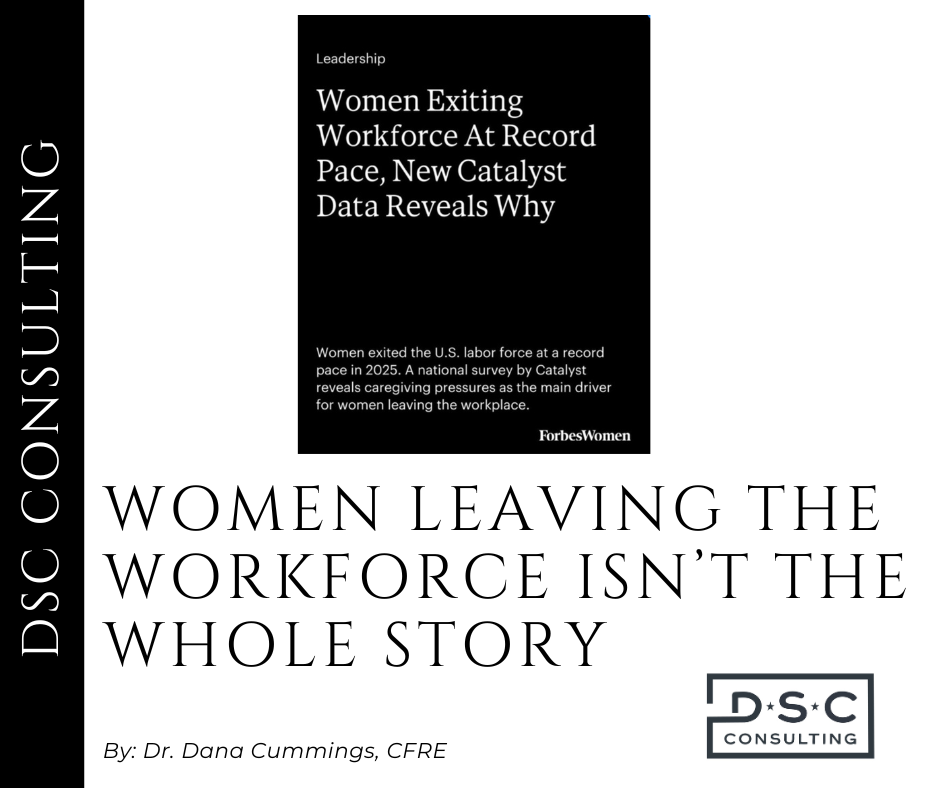
Recently, I read a Forbes article by Michelle Travis highlighting new data from Catalyst showing that women are exiting the workforce at a record pace. The findings are striking—and understandably concerning for organizations focused on talent retention, leadership pipelines, and long-term sustainability.
What caught my attention, though, was how closely many of the themes in the Catalyst data mirrored what I found in my own doctoral research and resulting dissertation on women and leadership.
And it led me to this conclusion: while women are leaving traditional employment, that story deserves more nuance than it’s often given.
Leaving a Job Is Not the Same as Opting Out
Much of the public narrative frames women’s departure from the workforce as a problem to be solved—or worse, a setback for progress. And to be clear, there are real systemic issues contributing to these exits: burnout, inflexible structures, inequitable expectations, and cultures that still ask women to absorb more than their share.
But here’s what often gets missed: women aren’t leaving work. They’re leaving certain kinds of work.
When women step away from traditional roles, many aren’t retreating at all. They’re starting businesses. They’re caring for children, aging parents, or loved ones in ways that don’t fit neatly into a standard job description. They’re consulting, freelancing, serving on boards, teaching, writing, and contributing in new and often deeply intentional ways. This isn’t disengagement; it’s redesign.
The Rise of Portfolio Careers
One framework that helps explain this shift is the idea of a portfolio career—a career made up of multiple roles, projects, and commitments rather than a single, full-time position with one employer.
Portfolio careers might include a blend of consulting work, part-time leadership roles, creative pursuits, caregiving, and community engagement. For many women, this model offers what traditional employment has struggled to provide:
- Flexibility without penalty
- Greater autonomy and agency
- Alignment with personal values and life seasons
- The ability to contribute meaningfully without burning out
In my doctoral research, I saw this pattern again and again: when organizational systems failed to evolve, women did.
And they didn’t do so impulsively. They did so thoughtfully, strategically, and often entrepreneurially.
From Reframe to Reality
Here’s the uncomfortable truth: when a talented woman leaves, it may very well be bad for the organization she’s leaving behind—but that doesn’t mean it’s bad for her.
This isn’t just theory for us. Both Andrea and I have made the decision to leave traditional employment in order to build work that better reflects our values and life seasons. DSC is the result of that choice—and of believing there are many valid ways to lead and contribute.
The Bigger Picture
The data tells us something important: women exiting traditional employment isn’t necessarily a failure of ambition or commitment. In many cases, it’s evidence of clarity.
So yes—women are leaving the workforce. But many are also building businesses, starting nonprofits, shaping communities, caring for others, and designing careers that work with their lives instead of against them.
This isn’t the crisis it’s often made out to be. But it is a signal worth understanding.